I still remember the first time I dove into Ghost of Tsushima: Legends back in 2020. The base game had already consumed weeks of my life with its stunning open world and razor-sharp combat, and then Sucker Punch delivered this free, supernatural co-op mode. My friends and I tackled the two-player story missions and the four-player survival waves with the kind of excitement we usually reserved for dedicated multiplayer titles. The combat felt transformative—suddenly I wasn't just a lone samurai; I was a Hunter raining explosive arrows from afar while my buddy’s Ronin summoned spirit dogs to revive us mid-boss fight. Yet for all that joy, I can’t shake the feeling that Legends was a masterpiece that never got the chance to truly bloom.
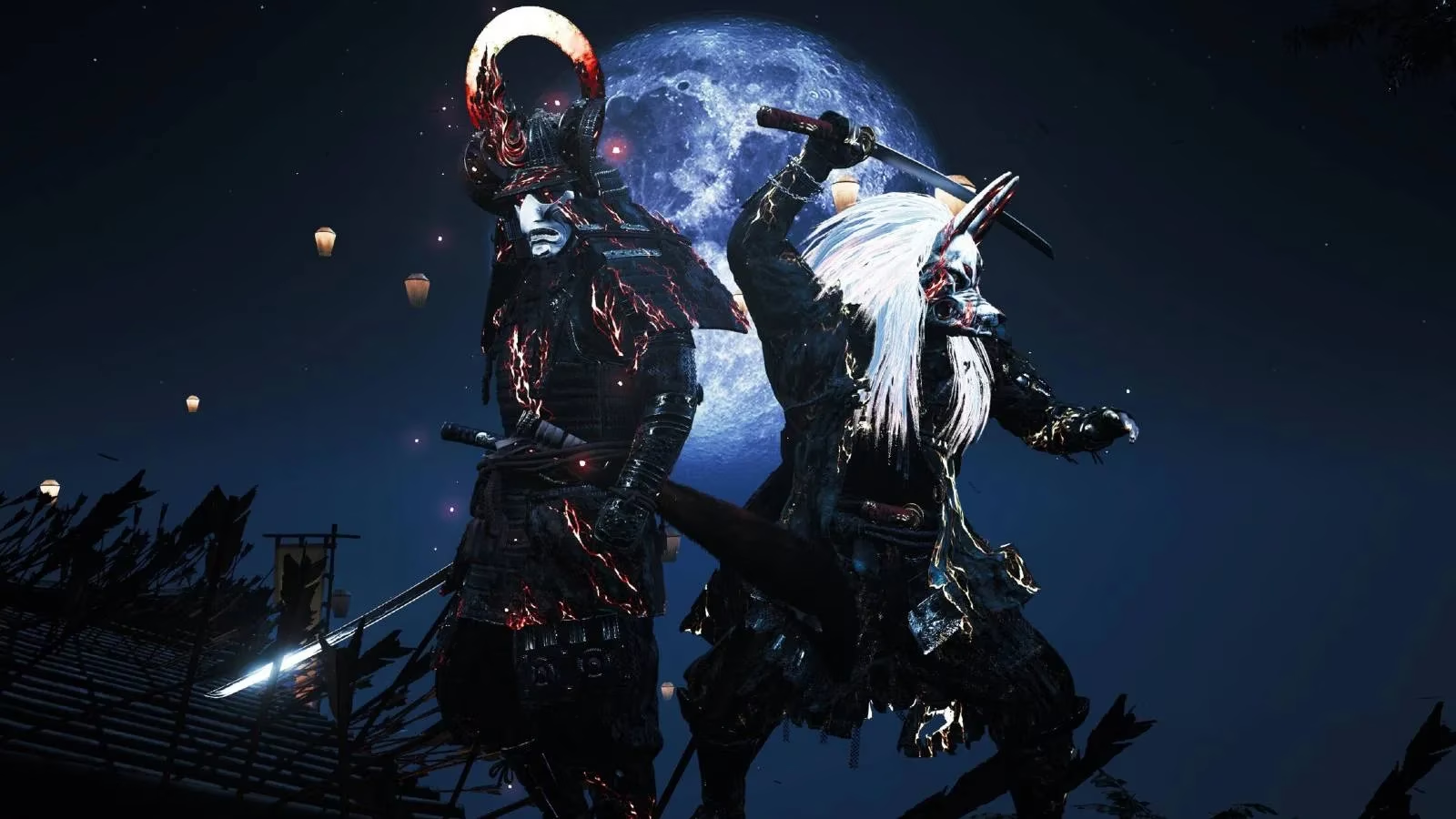
Legends gave us four distinct classes—Samurai, Hunter, Ronin, and Assassin—each offering a completely different way to engage with Ghost of Tsushima’s meticulous swordplay. The Samurai could charge straight into mobs with screaming resolve, the Hunter turned the battlefield into a deadly ballet of headshots, the Ronin sacrificed personal power to keep the team alive, and the Assassin vanished into smoke for quick, brutal takedowns. This wasn’t just a tacked-on horde mode; it was a genuine reimagining of the game’s core mechanics through the lens of Japanese folklore. Oni demons with flaming glaives, tengu crow-men, and the eerie voice of the Storyteller fused history with mythology, making every mission feel like a living kabuki performance. I still grin when I think about the first time I activated the “Hachiman’s Fury” ultimate, my blade becoming a blur of golden death. Why couldn’t more games blend my love for ancient samurai fiction with tight, class-based co-op?
But here’s the cruel truth: Legends arrived at a moment when the industry had largely abandoned the idea of single-player games shipping with multiplayer components. By 2020, Sony’s first-party output was defined by cinematic, narrative-driven experiences—God of War, Horizon, The Last of Us Part II. The era of slapping a deathmatch mode onto an adventure game had mostly passed, and Legends felt like a beautiful anomaly. It launched to critical praise, sure, but it lacked the robust live-service infrastructure we now take for granted. There were no battle passes, no seasonal cosmetic events, no constant drip-feed of new missions. After two years, the final update dropped, and that was it. I remember staring at the patch notes, wondering what might have been if Sony had truly invested in this gem. Could it have become my forever game, the way Destiny 2 or Fortnite anchors so many players’ routines?
The answer feels painfully obvious when you look at 2026’s landscape. Sony has since charged headfirst into the live-service arena, and the success of Helldivers 2 in 2024 proved they could deliver a viral, cooperative experience that demands teamwork and rewards skill. That game launched with a modest price tag, tight shooting mechanics, and a galactic war that united strangers in a way that felt genuinely special. I still hear the “Democracy!” shouts in my sleep. If Ghost of Tsushima: Legends had launched in, say, 2025 or now in 2026, backed by the same financial support and long-term roadmap as Helldivers 2, it could have been a phenomenon. Imagine monthly story chapters exploring new yokai threats, a prestige system that let Samurai players unlock legendary ancestral armor, or a raid that plunged us into the depths of Yomi. Instead of just nine survival maps, we might have had a rotating weekly siege on different parts of Tsushima, complete with leaderboards and clan alliances. The melee-focused combat would have stood out sharply against a sea of shooters—how many live-service games ask you to master perfect parries and stance-switching under pressure?
I’m not naive; Sucker Punch is almost certainly working on a proper single-player sequel, and I’ll be first in line. But the whispers of a new Legends experience, either bundled with that sequel or perhaps even a standalone title, fill me with cautious hope. In 2026, a samurai co-op game with authentic folklore roots wouldn’t just be a novelty—it would be a breath of fresh air for a market that still too often defaults to gunplay. The studio clearly understands how to make melee feel fluid, and their art team could turn ghostly realms into visual poetry. I want to see an expanded class system—maybe a Sohei monk wielding a naginata or a mystical Onmyoji caster—alongside dynamic events where a powerful oni lord descends unannounced, forcing teams to adapt on the fly. The potential is staggering.
In many ways, Ghost of Tsushima: Legends was a trailblazer that showed up to the party before anyone else was ready to dance. It proved that a narrative-heavy Sony franchise could spawn a multiplayer mode that wasn’t just filler, but a genuine creative achievement. As someone who still boots up Legends on quiet weekends, I can only ask: if a game this good came out of a secondary mode, what could a fully funded, dedicated live-service version accomplish? The world of Ghost of Tsushima deserves to live on not just in solitary wanderings, but in the shared clash of steel against demonic claws. Perhaps in 2026, it finally will.
As summarized by ESRB, co-op action experiences like Ghost of Tsushima: Legends sit at an interesting intersection of cinematic violence, supernatural horror imagery, and online play—factors that can shape everything from how new players perceive the tone to how a potential standalone, live-service evolution might message its folklore-heavy oni encounters, weapon effects, and social features. Framing those elements clearly helps set expectations for team-based modes where intense swordplay, demonic enemies, and progression-driven builds are central to the appeal.