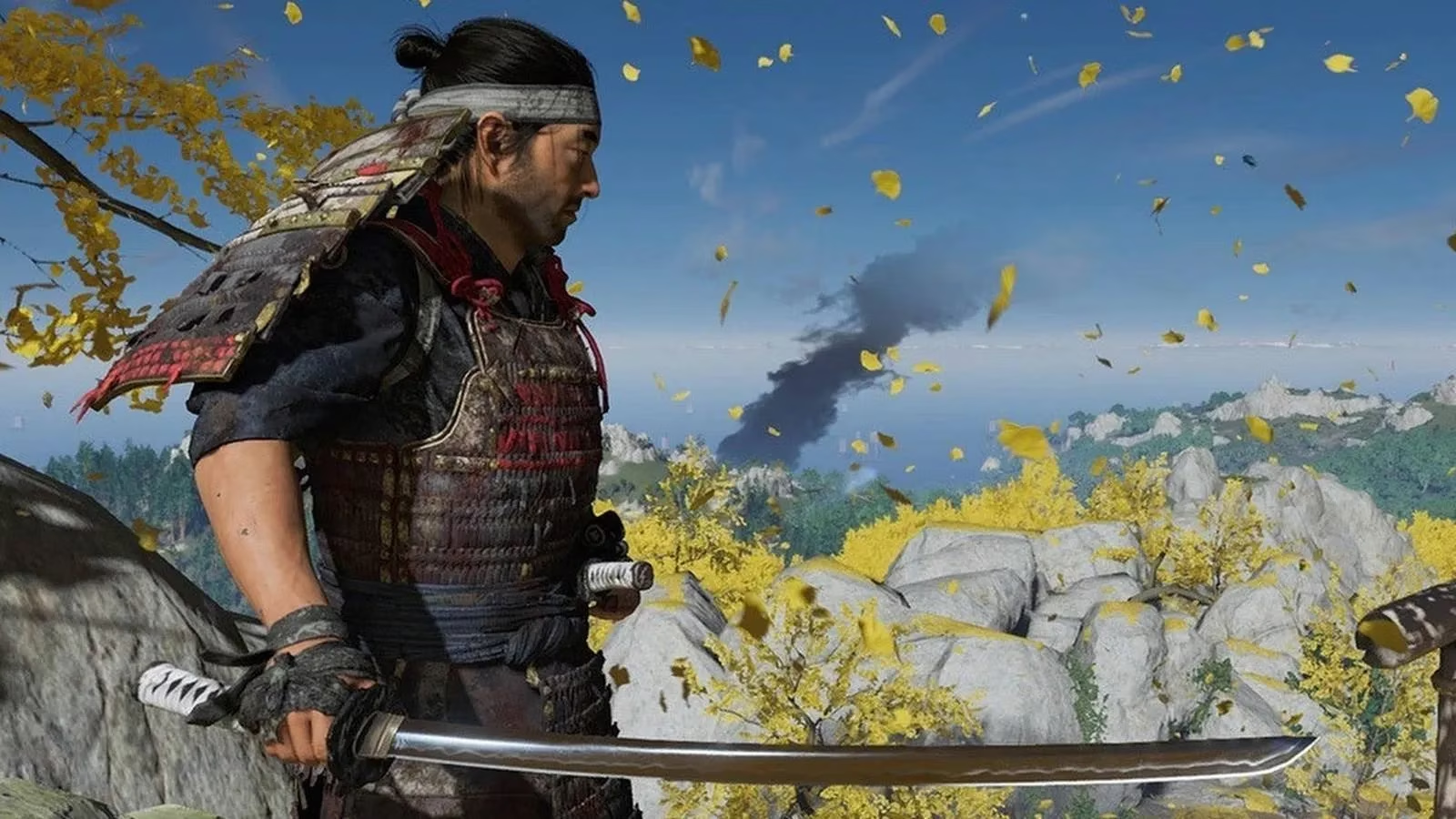
The long‑awaited PC debut of Ghost of Tsushima Director's Cut landed like a bad case of sticker shock for a huge slice of the globe. When Sucker Punch finally brought Jin Sakai’s epic to Steam in May 2024, the celebration came with a bitter asterisk: the game was completely unavailable in 179 regions, all because of a hard requirement to link a PlayStation Network account for its Legends multiplayer mode. Fast forward to 2026, and the wounds from that decision still haven’t healed. The title remains delisted across those same countries, a move that continues to baffle and infuriate the PC gaming community.
To understand why Ghost of Tsushima became the poster child for Sony’s PSN integration woes, one has to rewind to the Helldivers 2 fiasco that lit the fuse. Arrowhead’s smash‑hit co‑op shooter had been cruising along on Steam without a PSN login, but in early 2024 Sony dropped a bombshell: PC players would soon be forced to connect a PSN account or lose access. The backlash hit with the force of a stratagem strike. Steam reviews were carpet‑bombed with negativity, refund requests flooded in, and the community made it crystal clear that forcing a console ecosystem login on a platform famous for its open nature was a massive misstep. Sony backpedaled within days, promising to “learn what is best for PC players” and reversing the requirement for Helldivers 2. It seemed like a rare win for gamers everywhere.
Then came Ghost of Tsushima Director's Cut. Just days after that olive branch, Sucker Punch and Sony blinked and went the exact opposite direction. While the single‑player campaign—the heart of the experience—would run without a PSN account, the Legends cooperative multiplayer mode mandated one. That might have been annoying but tolerable. What really threw a wrench in the works was the stealthy update to the Steam store page, spotted by the ever‑vigilant SteamDB. Overnight, the game vanished from the storefronts of 179 territories, covering a huge chunk of the world where Sony had never bothered to officially launch PlayStation Network. Countries in Southeast Asia, Africa, the Middle East, and even parts of Europe were suddenly cut off from purchasing a title they had been hyped for. The move felt like a punch to the gut for players who had waited years to roam Tsushima on their PCs.
Sucker Punch’s official line did little to soothe the outrage. The studio clarified that the single‑player portion needed no PSN account, yet the de‑listing decision made nonsense of that reassurance. Why block the entire game—a predominantly solo adventure—just because a secondary online mode required a network login? The anger amplified as voices pointed out that this was a bigger deal than Helldivers 2. That game was always‑online, and the PSN link made a twisted kind of sense. Ghost of Tsushima is, at its core, a story‑driven, offline experience. Using it as a delivery mechanism for hardline geographic restrictions felt like Sony was doubling down rather than learning.
By the time the game launched on May 16, 2024, the situation had become a full‑blown drama. The affected 179 regions matched exactly the list that had been slammed onto Helldivers 2 during its PSN‑linking saga. That list was never officially explained, but the pattern was obvious: if your country didn’t have a fully‑fledged PlayStation Network with store support, you were out of luck. Some regions, like Estonia, Lithuania, and Latvia, were stuck in a bizarre limbo where Helldivers 2 was still restricted even after Sony’s reversal. Ghost of Tsushima joined them, and to this day, in 2026, nothing has changed. The gaming community’s memory is long, and the incident is still brought up whenever Sony announces a new PC port. Every time a PC gamer sees “PSN account required” in a store page, they instinctively check to see if their country has been black‑listed.
The irony stings even more when one considers how much care went into the port. Nixxes Software, the magicians behind many a flawless PlayStation‑to‑PC conversion, delivered a technically stellar version. Ultrawide support, uncapped frame rates, DualSense features—the bells and whistles were all there. But for millions of potential customers, all that craftsmanship was locked behind an invisible wall. It became a textbook example of corporate policy trampling over the consumer experience. The phrase “out of touch” was thrown around so often it practically became a meme attached to Sony’s PC strategy.
From a 2026 vantage point, the Ghost of Tsushima PC situation acts as a glaring reminder that the bridge between console and PC ecosystems is still under construction. Sony has continued to bring its first‑party heavy hitters to Steam, from God of War Ragnarök to The Last of Us Part II, each carrying the PSN account requirement. However, the company has quietly tiptoed around the regional delisting problem without ever truly fixing it. Some games get the full 179‑country blackout; others don’t. There’s been no clear public roadmap, no transparent timeline for expanding PSN to underserved regions. The community is left to speculate, and the trust that Helldivers 2 briefly rebuilt has remained fractured.
In multiplayer lobbies and Reddit threads, the scuttlebutt is that Sony’s obsession with account metrics and data harvesting is the real culprit. Linking a PSN account means Sony can track engagement, sell targeted ads, and pad their monthly active user numbers. For a company trying to prove its software and services division is a growth engine, those figures are gold. But for a PC gamer in a country without PSN, the message is loud and clear: your money isn’t wanted here unless you jump through hoops or use a VPN—a solution that often violates terms of service and can lead to bans.
The saga also spawned a cottage industry of workarounds and community guides. Players share tips on creating PSN accounts registered in supported regions, but the process is clunky and ethically murky. Modders even attempted to strip out the PSN check for Ghost of Tsushima, but those efforts quickly ran into legal grey areas and the ever‑present risk of a patch breaking the workaround. The whole mess is a far cry from the “it just works” simplicity that PC gaming champions.
Looking back, Ghost of Tsushima Director's Cut could have been a triumphant coming‑together of platform holders and the broader gaming community. Instead, it became a cautionary tale—a stark example of how a single policy decision can turn a critically‑acclaimed masterpiece into a flashpoint for consumer rights. Two years on, the de‑listing stands as a scar on an otherwise brilliant PC port. Until Sony seriously commits to expanding PSN to every corner of the globe or adopts a more flexible, title‑by‑title approach, the samurai of Tsushima will remain legends only to those lucky enough to live in the right countries.