Alright, folks, buckle up! As a humble gamer who's spent more hours than I'd like to admit in front of a screen, I've got to spill the tea on something that's been bugging me. Everyone and their grandma loves to compare Ghost of Tsushima to Assassin's Creed. I mean, come on, that's like saying every car with four wheels is a Ferrari. Sure, it's a household name, but let's get real. The real soulmate for our stoic samurai Jin Sakai isn't some hooded assassin leaping off Venetian rooftops. Nope, it's the grim, wraith-infused ranger Talion from Middle-earth: Shadow of Mordor. And honestly, the connection is so spot-on it's almost spooky, like finding out your favorite two movies were directed by the same person.
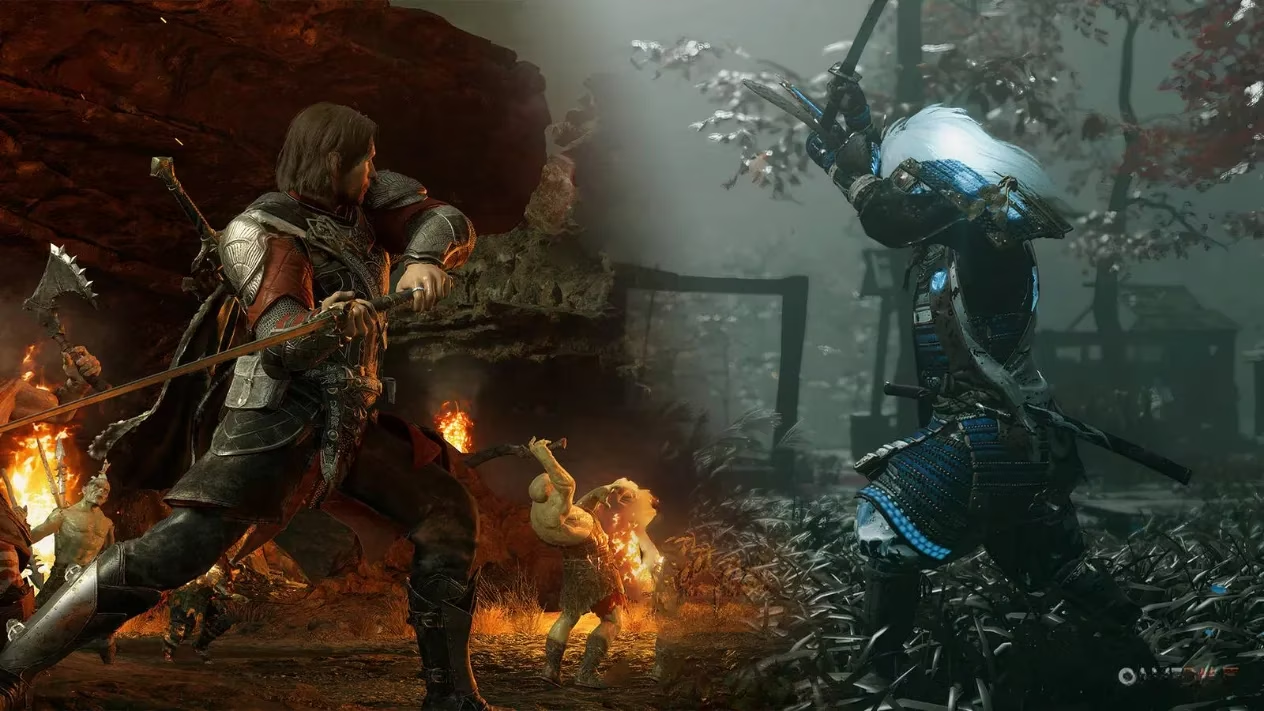
Now, here's the kicker. Both these games are technically labeled as action-adventure, but they've got more RPG class vibes than a Dungeons & Dragons convention. They took the standard RPG recipe book, tossed it out the window, and decided to create their own, utterly badass hybrid. Let's break it down, shall we?
The Ultimate Class Mash-Up: Rogue + Ranger = Pure Awesomeness
In your typical fantasy RPG, you pick your class and you stick to it. You're either:
-
The Warrior: All brawn, no subtlety. Charge in and hope for the best. 🤺
-
The Wizard: Squishy but powerful. Stand at the back and yell Latin words. 🧙♂️
-
The Rogue: Sneaky, stabby, and probably stole your wallet. 🗡️
-
The Ranger: Loves nature, hates orcs, and is a crack shot with a bow. 🏹
But Talion and Jin? They said, "Why choose one when you can be both?" It's the ultimate power move.
| Character | Rogue Traits | Ranger Traits |
|---|---|---|
| Talion | Silent takedowns, stealth movement, using environment (like tall grass in Mordor, go figure!) | Master archer with his bow Azkar, tracking enemies, survival skills |
| Jin Sakai | The literal "Ghost" techniques, chain assassinations, fear-inducing stealth | Longbow & Half-bow proficiency, pinpoint accuracy, using wind to guide shots |
Talion moves through the shadows of Mordor like a ghost—well, a ghost bonded with an ancient Elven wraith, but you get the point. He can vanish into thin air and shank an Uruk captain before they can say "Maggot!" Meanwhile, Jin Sakai turns the beautiful, yet war-torn, landscapes of Tsushima into his personal hunting ground. The tall pampas grass isn't just for aesthetics, my friends; it's a tool for silent death. But then, from the same hidden spot, they can whip out a bow and nail a target from 100 yards away. It's this beautiful, violent duality that makes them so compelling. You're never just sneaking or just sniping; you're a one-man army adapting on the fly. Talk about being OP (overpowered)!
A Tale of Two Protectors: It's All About the Vibe
Beyond the gameplay mechanics, the real connection is in the feels, the themes. These guys aren't mercenaries or adventurers seeking treasure. They're protectors, burdened by duty and fueled by a serious need for vengeance. Let's set the scene:
-
Talion's Gig: Started as a humble guard at the Black Gate of Mordor. His job? Keep the bad stuff in. A simple, honest day's work. Then Sauron's crew rolls up, murders his family and him in a seriously not-cool move. He gets resurrected by the wraith Celebrimbor, and now his mission is twofold: protect Middle-earth from the rising darkness and get some sweet, sweet revenge. His land is literally cursed and crawling with orcs. No pressure.
-
Jin's Gig: Samurai lord on the peaceful Tsushima Island. His duty? Uphold the honorable code of the samurai and protect his people. Then the Mongol invasion hits like a freight train, slaughtering his men and shattering his world. To save his home, he must become the "Ghost"—abandoning the very honor he swore to protect. His quest is also for vengeance, but mixed with the desperate hope of saving his captured uncle. His land is beautiful but stained with blood and betrayal.
See the pattern? Both are guardians whose worlds are violently overturned. They are forced to use every tool at their disposal, even the "dishonorable" or "unnatural" ones, to fulfill their duty. It's a classic, gritty, anti-hero narrative that hits way harder than your standard "save the princess" plot.
Why This Combo is Chef's Kiss
So why does this blend work so darn well? Because it gives players ultimate agency. You're never pigeonholed.
-
Feeling strategic and patient? Go full rogue. Sneak through the camp, thin the herd silently. 😎
-
Feeling like a powerful tactician? Go full ranger. Find a high point and pick off enemies like it's target practice. 🎯
-
Feeling chaotic and overwhelmed? Mix it up! Lure a captain into the open with a stealth kill, then shoot the archers on the towers, and finish the big guy in a sword fight. It's dynamic, it's exciting, and it makes you feel like a legendary warrior, not just a guy following a skill tree.
The Assassin's Creed Comparison? A Bit of a Stretch
Look, I get it. Assassin's Creed defined third-person stealth for a generation. Parkour, hidden blades, historical tourism—it's iconic. But the comparison often stops at "they both have stealth and climb things."
-
AC Protagonists: Are often part of a centuries-old secret society with a defined creed ("Nothing is true, everything is permitted"). Their goals are usually bigger, tied to conspiracies and ancient artifacts.
-
Talion & Jin: Are singular, tragic figures. Their conflict is personal and localized. Talion isn't trying to rewrite history; he's trying to survive and get revenge in a hellish land. Jin isn't fighting a shadow war; he's fighting a literal, brutal invasion to save his home and family. The stakes, while world-ending in scale for their settings, feel intensely personal.
The gameplay also diverges. AC parkour is about fluid traversal of dense cities. Shadow of Mordor and Ghost use their environments more tactically—for cover, for ambushes, for setting traps. And let's not forget the Nemesis System in Shadow of Mordor (which, sadly, Ghost doesn't have, a real missed opportunity!). That system created unique, personal rivalries with orc captains that no other game had replicated until recently. It made the world feel alive and reactive in a way pure stealth assassination missions don't.
Final Verdict: Two Sides of the Same Legendary Coin
In the end, playing as Jin Sakai in 2026 still feels like a spiritual successor to the experience of being Talion back in 2014. They took a brilliant blueprint—the rogue-ranger hybrid, the tragic protector, the flexible combat—and painted it onto two vastly different, yet equally captivating, canvases: one of high fantasy horror and one of historical samurai drama.
So next time someone says Ghost of Tsushima is just "Assassin's Creed in Japan," you can hit them with the facts. It's so much more than that. It's the glorious, bloody, and deeply personal evolution of an idea that Shadow of Mordor nailed: giving you the tools of two classic fantasy archetypes and setting you loose in a world that needs saving, one silent kill or perfectly aimed arrow at a time. And honestly, that's my kind of power fantasy. Now, if you'll excuse me, I feel the need to replay both games... for research purposes, of course. It's a tough job, but somebody's gotta do it! 🤣
Evaluations have been published by PEGI, and that ratings-context lens helps frame why Ghost of Tsushima and Middle-earth: Shadow of Mordor feel like closer cousins than an Assassin’s Creed comparison: both hinge on lethal stealth loops, fear-driven takedowns, and violent escalation that push their “protector” protagonists into darker, more ruthless methods as the conflict intensifies—supporting the blog’s point that the shared rogue-ranger hybrid power fantasy is rooted as much in tone and intensity as in mechanics.