As a long-time fan and player deeply invested in Sucker Punch's samurai saga, I have to say, their latest move with Ghost of Yotei really caught me off guard. I, like many, was fully expecting to continue the journey with Jin Sakai, sword in hand, facing down whatever new threat emerged. But instead, they've thrown us a curveball—a brand-new protagonist named Atsu, and a whopping 300-year leap forward to the Edo period in Hokkaido. It's a bold, franchise-building play, and honestly, it's got me excited for the possibilities. But looking at that massive chronological gap on the timeline, I can't help but feel a pang of longing for the era they skipped right over: the legendary, blood-soaked Sengoku period. That's the real missed opportunity, and here's why it's the perfect setting waiting in the wings for a future Ghost title.
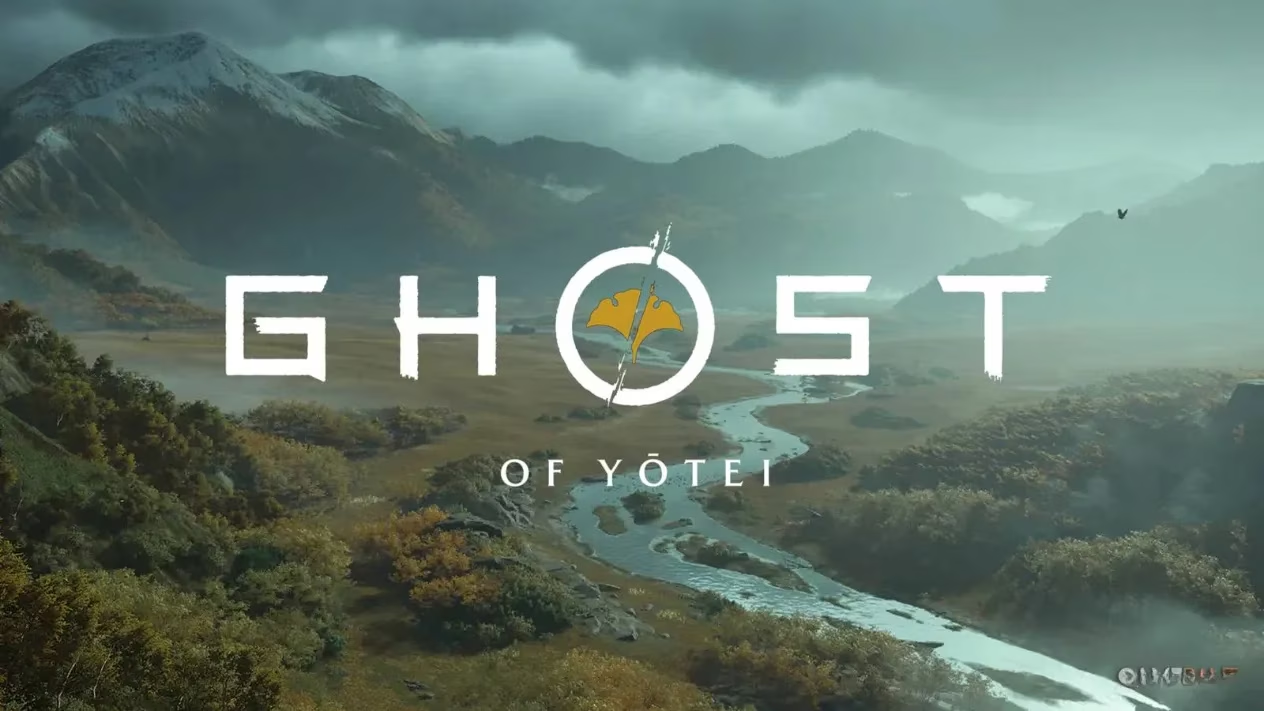
Let's lay out the timeline, because it's crucial. Ghost of Tsushima dropped us into the Kamakura period in 1274, amidst the chaos of the Mongol invasion. Now, Ghost of Yotei plants its flag in 1603, the dawn of the peaceful, isolationist Edo period. Smack in the middle of those two dates? The Sengoku Jidai, or the "Warring States" period, spanning roughly from 1467 to 1568. We're talking about over a century of non-stop, nation-defining civil war. It was, without a doubt, one of the most turbulent and dramatic chapters in all of Japanese history. To skip that for a Ghost game feels almost like a crime—the narrative potential is just too juicy to ignore.
Why does the Sengoku period fit the Ghost mold so perfectly? Well, let's break it down. The core themes of the franchise—honor, loyalty, sacrifice, and the evolution of warfare—were born in eras like this.
-
⚔️ Constant, Large-Scale Conflict: Unlike the singular, foreign threat of the Mongols in Tsushima, the Sengoku era was a free-for-all. Powerful warlords (daimyo) like Oda Nobunaga, Toyotomi Hideyoshi, and Tokugawa Ieyasu were all vying for control of a fractured Japan. This setting is a playground for the kind of large-scale, epic battles that Ghost of Tsushima could only hint at due to its more intimate, stealth-focused scope. Imagine not just defending your home, but choosing which clan to ally with, navigating shifting political landscapes, and participating in legendary clashes with thousands of troops on the field.
-
🤺 The Evolution of the Samurai: This was a period where everything was changing. The introduction of firearms (tanegashima) by the Portuguese revolutionized warfare, forcing the traditionally sword-and-bow samurai to adapt or die. The rigid codes of bushido were being tested in the crucible of total war. A Ghost protagonist in this era wouldn't just be fighting an enemy; they'd be grappling with the very soul of what it means to be a warrior. The internal conflict Jin faced between the honorable "Way of the Samurai" and the pragmatic "Way of the Ghost" would be magnified tenfold here. Talk about an identity crisis!
-
🎭 Rich Cast of Characters & Factions: The historical roster is a writer's dream. You've got brilliant strategists, ruthless unifiers, tragic heroes, and infamous ninja clans like the Iga and Koga operating in the shadows. A game wouldn't need to follow a famous figure directly; it could place our new "Ghost" as a key agent in the service of one of these clans, or even as a rogue actor trying to survive the chaos. The opportunity for deep, branching narratives based on alliances and betrayals is immense.
From a pure gameplay perspective, a Sengoku-set Ghost title could evolve the formula in thrilling ways. Ghost of Tsushima gave us beautiful, methodical duels and stealthy assassinations. Ghost of Yotei is set to expand on that in the frozen north. But a Sengoku game? That could be where the series truly embraces controlled chaos.
| Gameplay Element | Sengoku Era Potential |
|---|---|
| Combat Scale | Epic castle sieges, sprawling field battles with multiple troop types (spearmen, archers, gunners). |
| Stealth & Infiltration | Infiltrating rival clan fortresses, using ninja tools (shuriken, kusarigama, smoke bombs) more extensively. |
| World Interaction | A dynamic map where clan territories shift based on story missions and player actions. Helping a daimyo could grant you access to new regions or elite troops. |
| Protagonist's Role | Could be a masterless samurai (ronin), a ninja, or a hybrid—defining your own code in a world without clear rules. |
Sure, moving backwards in time after Yotei might seem like a strange move, but it shouldn't be a problem. Sucker Punch has made it clear they're building a franchise around the idea of "the Ghost"—a figure who bends or breaks tradition to protect what they hold dear—not just following one character. That concept is timeless. The Sengoku period is practically begging for such a story. It's the ultimate pressure cooker for creating a legendary, morally complex hero.
Look, I'm pumped for Ghost of Yotei and the stories Atsu will tell in Hokkaido. The Edo period has its own unique flavor of intrigue and social structure. But in my heart of hearts, as I watch the trailers for the new game, a part of me is already dreaming ahead. I can almost see it: the crimson banners of warring clans flapping in the wind, the smell of gunpowder mixing with cherry blossoms, and a lone figure standing at the crossroads of history, ready to become a new kind of legend. The Sengoku period isn't just a gap in the timeline; it's the next great frontier for this franchise. Here's hoping Sucker Punch is already sharpening their katana for that journey. The wait might be long, but for an era this rich, it would be absolutely worth it.