As a dedicated follower of Sucker Punch's work, I find myself reflecting on the monumental achievement that was Ghost of Tsushima. Its 2020 release didn't just deliver a gripping samurai tale; it crafted one of the most serene and immersive open worlds in gaming history. The rolling fields, tranquil forests, and windswept cliffs of Tsushima Island weren't just a backdrop—they were a character in their own right, a digital love letter to feudal Japan's natural beauty. Now, as we look ahead to Ghost of Yotei, the question on every fan's mind is a daunting one: how do you follow up on near-perfection? The answer, it seems, might be found not just in a new story, but by looking up.
The secret ingredient for Ghost of Yotei's success may well lie in a dimension its predecessor largely treated with caution: verticality. While Ghost of Tsushima offered a breathtakingly beautiful world, its landscapes were predominantly horizontal, inviting exploration across plains and shorelines. Don't get me wrong—scaling the occasional marked cliff to reach a Shinto shrine provided some of the game's most memorable, spine-tingling vistas. But these moments were carefully curated exceptions, not the rule of the world. The core traversal was grounded, which suited the island's geography but left a tantalizing question: what if the world itself was built to be climbed?
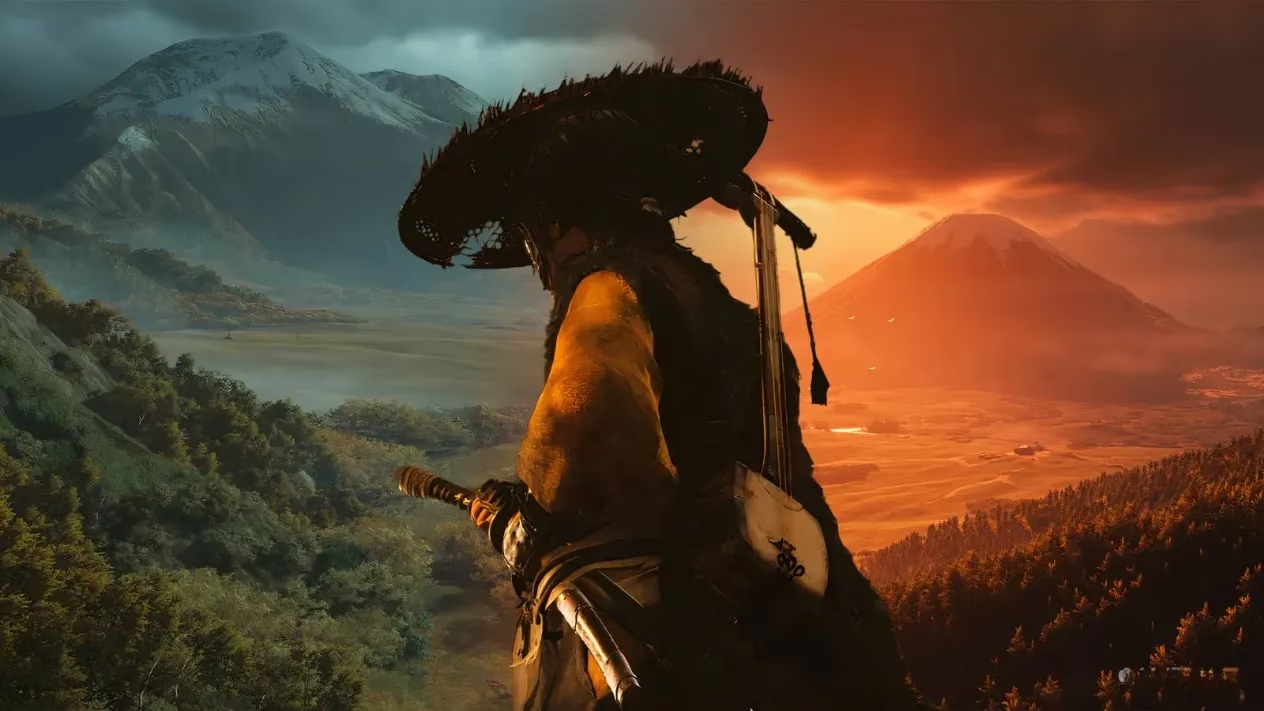
This is where Ghost of Yotei's shift to Ezo—modern-day Hokkaido—becomes a game-changer. The very setting, centered around the formidable Mount Yotei, is a promise of elevation. Think about it: an active volcano as the heart of your game world inherently suggests peaks to conquer, ridges to traverse, and valleys far below to survey. Could this be the key to creating a world that feels distinct from Tsushima's pastoral beauty while being equally awe-inspiring? The official website's description hints strongly at this, teasing "massive sightlines that let you look far across the environment." This phrase alone suggests a design philosophy built around vantage points and layered exploration.
Let's contrast this with the established norms. In Ghost of Tsushima, verticality served specific, contained purposes:
-
Shrine Ascents: Purpose-built climbs leading to a single, spectacular payoff.
-
Tactical Elevation: Using rooftops or watchtowers for stealth during missions.
-
Visual Variety: Breaking up the landscape to prevent it from feeling too flat.
It was effective, but functional. Now, consider how other open-world giants handle height. Games like Assassin's Creed Shadows or The Legend of Zelda: Breath of the Wild weave verticality into their core DNA. Climbing isn't just a means to an end; it's a primary verb, a way of interacting with and understanding the space. The world is designed in three dimensions, with secrets tucked away on cliff faces, puzzles that require assessing altitude, and navigation that constantly asks, "Can I get up there?"
This is the potential paradigm shift for Ghost of Yotei. Imagine not just visiting a shrine on a hill, but navigating the treacherous, snow-packed slopes of Mount Yotei itself. Picture using verticality not just for sightseeing, but for core gameplay: ambushing Mongol patrols from a pine-covered ridge, using a sheer cliff face as an escape route, or discovering hidden Ainu settlements nestled in a mountain pass inaccessible from the ground. The vertical world becomes a playground for the ghost.
| Aspect | Ghost of Tsushima (2020) | Ghost of Yotei (2026) |
|---|---|---|
| Primary Setting | Tsushima Island (relatively flat, coastal) | Ezo/Hokkaido (mountainous, volcanic) |
| Core Vertical Traversal | Context-sensitive climbing on marked surfaces | Promised "massive sightlines," implying integrated climbing/exploration |
| World Design Philosophy | Horizontal exploration with curated high points | Verticality as a foundational, explorable dimension |
| Tactical Use of Height | Limited to specific mission areas (rooftops, towers) | Potentially central to navigation, stealth, and combat |
The implications are thrilling. From a narrative perspective, the climb could mirror the protagonist's internal struggle—each arduous ascent reflecting a step closer to their goal or a burden shouldered. From a visual standpoint, the team at Sucker Punch, masters of atmospheric beauty, would have a new canvas. We could witness the aurora borealis from a frozen peak, track storms rolling across vast valleys, or use the height to plan our approach to a distant fortress. The "wind" guidance system could evolve into something that helps us navigate not just across the land, but up it.
Of course, with great height comes great responsibility. A more vertical world demands refined movement mechanics. Will we see a more fluid and dynamic climbing system? Could there be tools like grappling hooks or ice axes? Furthermore, how does this affect the beloved, cinematic Kurosawa mode? Filtering a vertigo-inducing climb through a monochrome lens could produce some truly unforgettable, nerve-wracking sequences.
Ultimately, the move towards verticality feels like a natural and bold evolution. Ghost of Tsushima mastered the art of the horizon. Ghost of Yotei seems poised to master the skyline. By building its world upward, Sucker Punch isn't just changing the scenery; they're potentially redefining the very feel of being a ghost. The silence of the snow-covered peak, the strategic advantage of the high ground, the sheer scale of looking down on a world you must protect—these are the new frontiers. As we await its release, one thing is clear: the path to surpassing a legend doesn't always lead forward. Sometimes, it leads straight up.