As a dedicated player who has spent countless hours mastering the blade and the shadows of Tsushima, the announcement of Ghost of Yotei has me both excited and deeply contemplative. Mark your calendars for October 2, 2026—the day we travel to a new, frostbitten frontier. While we've had to wait a bit longer than some hoped, the promise of a fresh protagonist, a new story, and evolved gameplay is more than enough to sustain the anticipation. However, after pouring over the available details, I believe the most profound shift won't be in the mechanics or the setting, but in the very soul of the narrative. Ghost of Yotei appears ready to challenge the heroic legacy Jin Sakai carved, presenting a Ghost driven not by noble sacrifice, but by raw, personal vengeance.
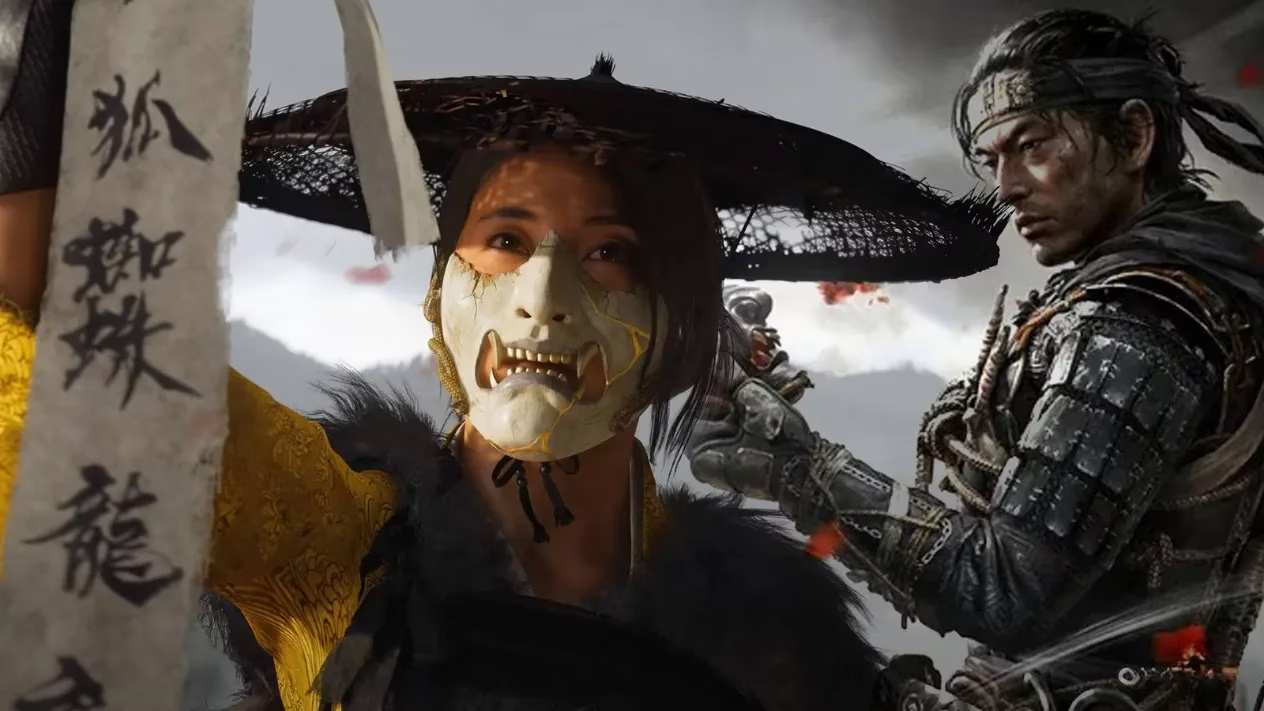
Let's rewind for a moment. In Ghost of Tsushima, we lived Jin Sakai's internal conflict. His heart was the true battlefield. Raised in the strict, honorable code of the samurai, he was conditioned to face his enemies directly. Yet, faced with the brutal Mongol invasion, he made a conscious, painful choice to abandon that code. He became the Ghost—a creature of the shadows who struck unseen. This was a rebellion romanticized by necessity. While his uncle Lord Shimura saw only dishonor, we, as players, understood the greater purpose. Jin's transformation was for Tsushima. It was to protect his home and its people from annihilation, a cause far greater than himself. The Ghost became a symbol of necessary evil for an ultimate good, a protector who sacrificed his honor to save countless lives.
Now, enter Atsu, our new protagonist in Ghost of Yotei. Her origin story is one of pure, unadulterated tragedy. A group known as the 'Yotei Six' razed her homestead and slaughtered her family. Her mission is not to save a nation, but to enact vengeance. Herein lies the seismic narrative shift. Atsu adopts the mantle of the Ghost not for a noble cause, but as the most effective tool for personal retribution. This fundamental difference in motivation is poised to completely reframe what it means to be the Ghost. Jin blurred the line between good and evil; Atsu might start her journey squarely on a path traditionally viewed as darker, driven by a motive rarely celebrated as virtuous: revenge.
This premise allows Ghost of Yotei to explore a theme its predecessor only hinted at: the corrupting potential of the Ghost's power. What if the methods of the Ghost—stealth, fear, assassination—are detached from a righteous cause? The game's setup boldly suggests that the dishonorable conduct Jin adopted for salvation could be wielded for purely selfish, destructive ends. It's a chilling and brilliant evolution of the franchise's core concept. The gameplay tools we'll master—the silent takedowns, the strategic use of fear—may feel morally heavier this time around. Every arrow fired from the shadows, every enemy terrified before they die, will be in service of Atsu's personal war, not a communal one.
Of course, as seasoned gamers, we know character arcs are everything. It is highly probable, even expected, that Atsu's journey will involve a transformation. Her path of vengeance could very well lead her to a larger conflict or a moment of redemption where she chooses to use her skills for a purpose beyond herself. The narrative could beautifully mirror a player's own potential weariness with endless retribution, guiding both Atsu and the player toward a more enlightened use of the Ghost's power. This potential for growth is what makes her such a compelling character to step into.
Yet, what if Sucker Punch subverts that expectation? 😲 What if Ghost of Yotei has the courage to follow a revenge story to its logical, bitter conclusion? The ending could leave us questioning whether the persona of the Ghost is a force for good at all, or merely a mask for humanity's darkest impulses. This would be a monumental narrative risk, but one that could cement Ghost of Yotei as a landmark title in video game storytelling. It would force us to re-evaluate Jin's legacy not as a heroic standard, but as a specific, context-dependent choice.
From a gameplay perspective, this narrative foundation opens incredible doors. Our actions in the world could have a different tonal weight:
-
Stealth Takedowns: In Tsushima, these felt like necessary tactics of war. In Yotei, they may feel more like cold, personal executions.
-
Fear Mechanics: Using tools to terrify the Yotei Six might deliver a more visceral, personal satisfaction rather than a strategic advantage in a larger battle.
-
Character Interactions: How will the people of this new region react to a Ghost who is not their protector, but a specter of someone else's feud?
The contrast between the two Ghosts can be summarized simply:
| Aspect | Jin Sakai (Ghost of Tsushima) | Atsu (Ghost of Yotei) |
|---|---|---|
| Primary Motivation | Protection of Tsushima & its people | Personal vengeance for her family |
| Moral Starting Point | Honor-bound samurai | Grieving victim turned hunter |
| Perceived Purpose | Greater good, necessary evil | Personal justice, potentially selfish |
| Symbolic Legacy | Romanticized rebel protector | Ambiguous avenger |
As I look ahead to October, my excitement is tinged with a sense of solemn curiosity. We are not just getting a new Ghost game; we are getting a crucial counterpoint to the first. Ghost of Yotei is prepared to stare unflinchingly at a truth Ghost of Tsushima could only glance at: that the power of the Ghost is morally neutral. It is a weapon, and a weapon's nature is defined entirely by the hand that wields it and the heart that guides it. Jin Sakai's heart sought salvation for others. We must now walk in the snow with Atsu and discover if her heart, shattered by loss, can find a purpose beyond its own broken pieces, or if it will lead the legend of the Ghost into a new, darker era. The legacy is in her hands, and ultimately, in ours.