Gaming has a peculiar relationship with memory. Every week brings another wave of releases that crashes into the market like a rogue current, dragging older titles into the ocean floor of collective amnesia. I get it—there are only so many hours in a day. But as someone who has spent the last year revisiting the forgotten shelves of my own digital library, I find it almost criminal how many brilliant experiences have been washed away simply because the industry moves at the speed of a caffeinated hummingbird. The games below are not obscure indie experiments or niche curiosities. Some were massive hits at launch. Others redefined genres. Yet here in 2026, they are shadows—playing second fiddle to whatever juggernaut occupies the front page this month. Let me dust off a few of them.
Ghost of Tsushima
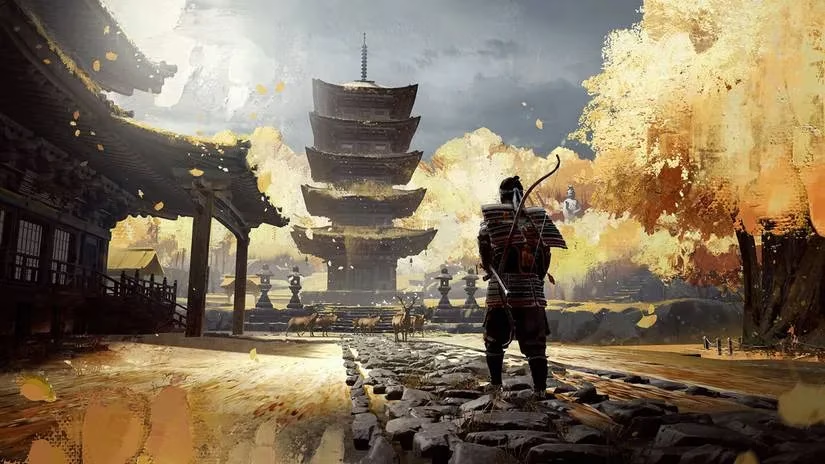
In the months after Ghost of Tsushima launched in 2020, it was everywhere—and deservedly so. A sprawling open-world historical fantasy with visual poetry, a soundtrack that could make a stone weep, and melee combat so fluid it felt like playing a Kurosawa film. It won Game of the Year from multiple outlets. Then the conversation shifted. Elden Ring arrived, followed by Horizon: Forbidden West, and the gaming community behaved like a crowd at a fireworks show—oohing and aahing at the newest burst while forgetting the previous one entirely.
I replayed Ghost of Tsushima earlier this year, and the experience still holds up like a katana forged from timeless design principles. The island's beauty remains a benchmark for open-world atmosphere. The moment I stood in a golden forest, watching leaves spiral around Jin as he unsheathed his blade, I realized this game had not aged—it had simply been left behind like a samurai poem no one recites anymore. If you missed it, you are missing one of the finest tone pieces of the last console generation.
System Shock
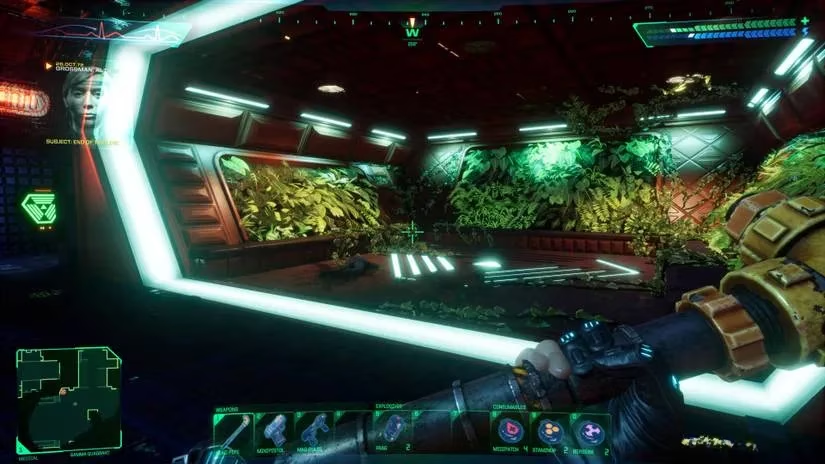
System Shock 2 gets most of the glory, and I understand why. Its villain, its systems-driven design, its terrifying atmosphere—these elements birthed the immersive sim genre as we know it. But the original System Shock was the spark that lit that fire, and it deserves far more than a footnote in gaming history.
When Nightdive Studios finally released the long-gestating remake on May 30, 2023, I dove in with both curiosity and trepidation. What I found was not a museum piece but a living, breathing shadow of dread. Players are not guided by objective markers or hand-holding tutorials. You are simply dropped onto Citadel Station and left to navigate its hostile corridors like a lab rat in a maze built by a vengeful machine. S.H.O.D.A.N., the rogue AI who is effectively the station itself, turns every airlock, every terminal, every dimly lit hallway into a potential death trap. The level design rewards patience and exploration. The freedom to approach problems with different weapons, cybernetic upgrades, and strategies gives the remake a modern relevance that belies its 1994 origin.
I have played many sci-fi horror titles in the last few years, but few have made me feel so deliberately unsupervised. For players who crave games that trust their intelligence rather than insult it, System Shock remains a lighthouse in a sea of autopilot quest logs.
Observation
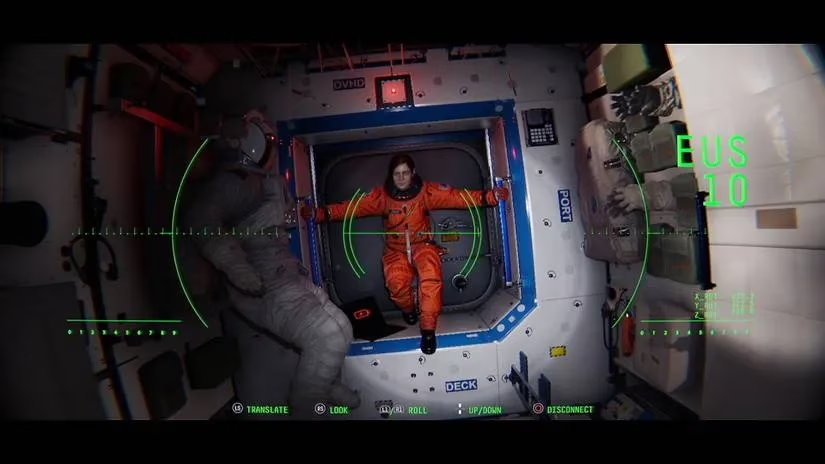
2019 was a monster year for games. Resident Evil 2 returned with a vengeance. Fire Emblem: Three Houses consumed hundreds of hours for strategy fans. Amid this noise, No Code's Observation arrived like a whisper and left like a ghost. That is a shame, because it is one of the most distinctive storytelling experiments I have ever played.
The premise sounds conventional at first: Dr. Emma Fisher, a scientist on a space station orbiting Saturn, experiences strange and terrifying events. But you do not play as Dr. Fisher. You play as S.A.M., the station's AI—initially little more than an interactive operating system, but one that gradually becomes something far more complex. The shift from passive observer to active participant unfolds with a subtlety that some players might miss if they rush through. Observation asks you to navigate cameras, control systems, and solve puzzles not as a human hero, but as a consciousness learning what it means to act with intention.
The story is not entirely unpredictable, but its execution is so deliberate and atmospheric that predictability never feels like a flaw. It lingers afterward like the afterimage of a bright light. In an industry where most protagonists wield guns or swords, letting the player become the station itself was a risk that paid off beautifully.
The Forgotten City
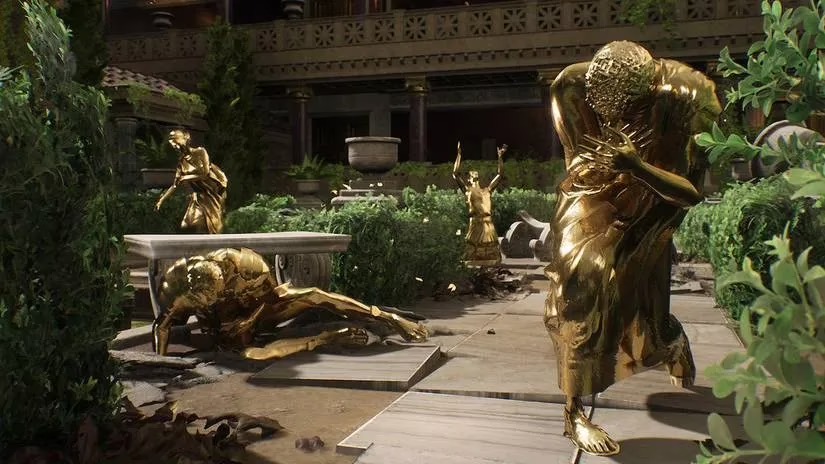
The Forgotten City began as a Skyrim mod, which makes its eventual success as a standalone title all the more remarkable. Stripping away the Dwemer setting and rebuilding it as an ancient Roman mystery was a bold move. Against all odds, it worked beautifully.
The premise is elegant: a modern-day outsider finds themselves in a thriving Roman city protected by a strict law—if anyone commits a sin, the gods will destroy everyone. The loop mechanic traps the player in a time spiral, forcing them to learn the rhythms of the city, its inhabitants, and the web of moral compromises beneath its golden facade. Each loop peels back another layer, like peeling an onion whose core is a philosophical dilemma about law, freedom, and human nature.
I have played narrative-heavy games where choices matter. I have played time-loop games where experimentation is encouraged. But The Forgotten City accomplishes both while never feeling mechanical. The decisions I made carried weight not because the game told me they did, but because I had come to know the people behind them. It is a masterclass in small-scale storytelling, and proof that the modding scene still contains unexplored veins of gold.
Journey to the Savage Planet
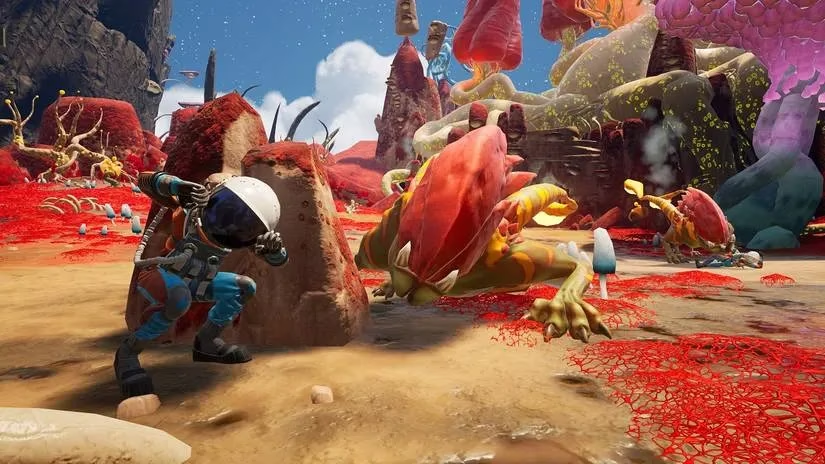
Comedy in games is a notoriously difficult needle to thread. The problem is not that jokes are bad; it is that players spend so much time in a game world that the humor eventually becomes wallpaper. Deadpool had this problem. High on Life had this problem. Borderlands 3 had this problem. They start funny, then the jokes repeat until they become as grating as a doorbell ringing for the hundredth time.
Journey to the Savage Planet sidesteps this trap through a kind of internal consistency that is almost zen-like in its absurdity. The universe is utterly ridiculous, but no one in the game seems to notice. They treat the lunacy as completely normal, and that gap between the audience's reaction and the characters' indifference becomes the joke itself. The humor does not shout for attention. It just exists, like a weird mushroom that happens to sing opera.
This approach kept me genuinely laughing from the first alien encounter to the final corporate satire. More importantly, it demonstrates that comedy can carry a full game when it is woven into the world rather than delivered through punchlines. The industry should study this game like a botanist examining an unknown flower—not to replicate its exact jokes, but to understand why they bloom repeatedly without wilting.
These five games, each excellent in its own way, share an unfortunate fate: they have largely drifted out of the current conversation. The gaming ecosystem in 2026 is denser than ever, and I understand why it is hard to keep up. But we lose something valuable when we let excellent work slide into obscurity simply because newer titles demand attention. Think of these recommendations as a rescue mission, not a nostalgia trip. The games I have described remain vital, playable, and profoundly rewarding for anyone willing to look past the release calendar's relentless forward march. Pick one up. You might find a favorite you never knew existed. And if you have your own overlooked masters to champion, share them—the deeper we dig, the richer this medium becomes.