In the drifting mists of May 2024, a lone samurai crossed an invisible sea and made landfall upon a vast, unfamiliar shore. The shore was Steam, the digital archipelago where countless warriors had already carved their names, but none with a blade so quiet and so absolute. Ghost of Tsushima arrived not as a comet, but as a patiently waiting storm—its Director’s Cut edition a perfect vessel carrying the base campaign, the windswept Iki Island, and the mythic echoes of Legends. Within days, the game became Sony’s largest single-player launch on PC, its peak of 77,154 concurrent players blooming like an evening primrose that chooses to open only after dusk has settled. It was a record woven from silk and steel, unspectacular in its swiftness yet iridescent in its endurance.
Sony had already transplanted gods, heroes, and machine-tamers to this personal computer wilderness. God of War had swung its icy axe and gathered 73,529 souls at its highest roar; Marvel’s Spider-Man had flung 66,436 web-strung dreamers through a digitized Manhattan; Horizon Zero Dawn and its sequel kindled twin beacons of 56,557 and 40,462. Yet the wandering Jin Sakai, a mere mortal carrying only code and the ghost of his code, eclipsed them all. Why? Perhaps because his journey felt less like a blockbuster formula and more like a haiku brushed onto water—every duel a breath, every fox-guarded shrine a sigh. The game’s performance on Steam was a quiet coup, a long bow drawn not with ostentation but with the patient tension of a bamboo grove bending under snow.
One could perceive it as an echo of the kensei—the sword saint who perfects a single strike after a lifetime of stillness. The Director’s Cut bundled everything into one immaculate sheath: the main tale of honor and sacrifice, the multiplayer Legends mode where spectral warriors howl under a moon that weeps, and the Iki Island expansion that deepened the scar of memory. For the PC audience, this was not merely a port; it was an all-invitation, a complete offering like a tea ceremony where each vessel contributes to an indescribable balance. Nixxes Software, the alchemists charged with the conversion, wove their magic so seamlessly that many players forgot the code had ever belonged to another realm.

The numbers themselves read like a constellation mapped across a spring night. Where Ratchet and Clank: Rift Apart glimmered at 8,757, and Miles Morales spun a modest 13,539, the Ghost spoke in a language of 77,000 whispers. Only Helldivers 2, the great cooperative leviathan with its 458,709 peak, roared louder—but that was a multiplayer thunderstorm, while this was a single-player moonlight. The distinction mattered, for it proved that a solitary narrative, devoid of battle passes or continuous feeds, could still draw a crowd as wide as a rice paddy stretching toward the invisible ocean.
Two winters have passed since that debut, and in this 2026 of ours, the samurai’s legacy has only ripened. Rumors that once fluttered around a PlayStation Showcase have crystallized into a sequel, a second breath that now resides on both console and PC from its first dawn. The original Ghost of Tsushima remains a living monument—a garden in perpetual autumn where new souls still arrive to bow at torii gates. Its record has been challenged, perhaps even shattered by its own offspring, yet the initial flash of that 2024 launch lingers like the afterimage of a lightning bolt viewed through closed eyelids. It reshaped Sony’s understanding of its own treasures, revealing that a story steeped in feudal echoes and monochrome cinema modes could become a lodestar without shedding its poetic core.
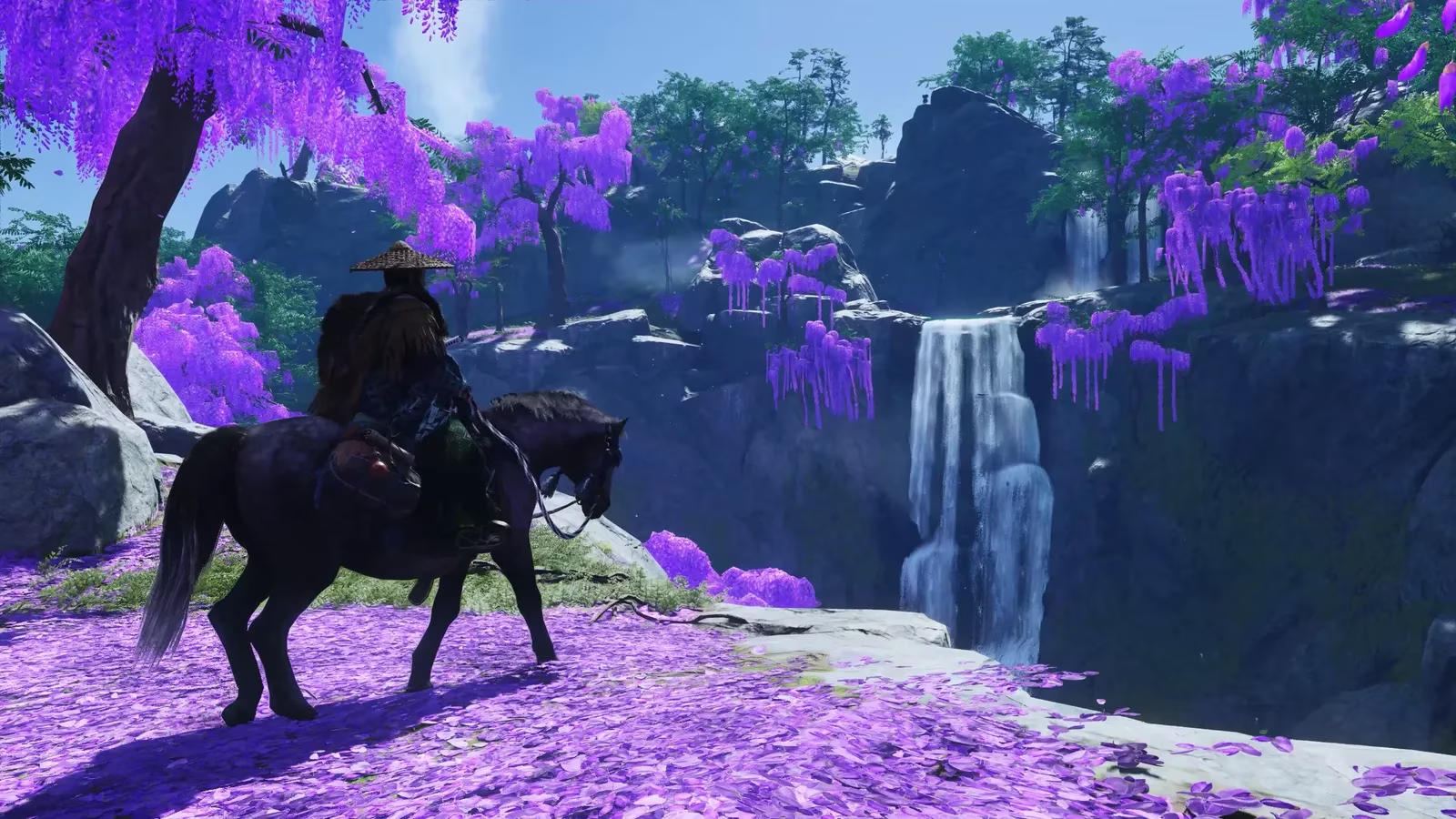
Travelers on the Steam winds today can still mount a horse named Kage and ride through pampas grass that sings like a child’s memory of home. They can face a Mongols’ camp with nothing but a partially drawn blade and the unspoken rhythm that turns combat into a calligrapher’s stroke. The Director’s Cut remains a favorite purchase, a living testament to how complete art—unhurried, unbroken—outlasts the frantic parade. It is a ronin among offerings, belonging to no single faction, answering only to the wind. And so the Ghost endures, not as a dead legend, but as a haunting melody that taught an entire platform to listen more closely to the silence between slashes.