By 2026, Trek to Yomi has settled into a different role than the one it occupied when it was first announced. The black-and-white samurai action game from Polish developer Flying Wild Hog and Texas-based publisher Devolver Digital began as a stylish promise: a Kurosawa-inspired homage about a young swordsman named Hiroki, bound by a vow to his dying master to protect his town and the people he loves. Announced in June 2021 and released in spring 2022, the game now reads less like an upcoming curiosity and more like a finished cult item. It is compact, cinematic, and combat-focused, with a story built on duty, tragedy, revenge, honor, and swordfighting. For players discovering it in 2026, the question is not whether it looks like a classic samurai film. The question is whether that film-like surface supports a game that still feels worth drawing a katana for.
A Vow, a Town, and a Journey Beyond Death
Trek to Yomi places Hiroki at the center of a familiar but potent samurai tragedy. His master is dying, and Hiroki swears to protect his town and the people he loves against all threats. That vow sounds simple until the game applies pressure. Tragedy strikes, duty binds him, and the lone samurai must voyage beyond life and death to confront himself and decide his path forward. The premise leans into the archetypes that have powered samurai cinema for decades: loyalty, loss, revenge, and the burden of honor. Does a story need to reinvent those ideas to be effective? Not necessarily. The reference material makes clear that Trek to Yomi treats them as foundations rather than decorations.
The title itself points toward the supernatural. Yomi is the underworld in Japanese mythology, and the game uses that space to push Hiroki beyond ordinary revenge. The gameplay trailer only briefly shows an enemy who could be supernatural, but the promise is there. A samurai story can be intimate and grounded, yet Trek to Yomi also wants a mythic edge. That combination gives the journey a sharper identity than a straightforward tale of a swordsman cutting through bandits.
Combat With the Rhythm of an Old Samurai Film
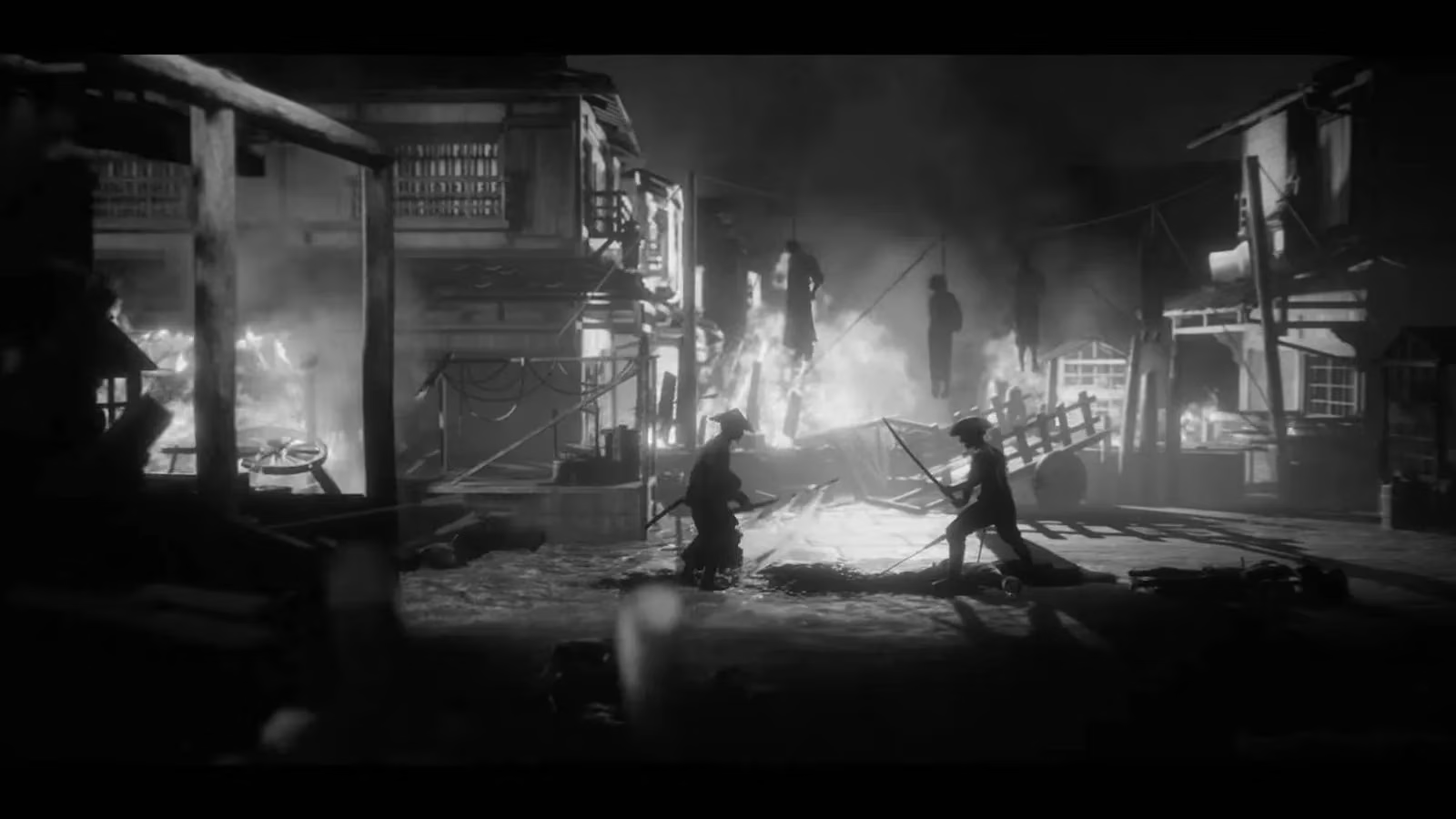
The gameplay trailer emphasizes tight, focused combat. Narrow paths and somewhat linear levels recall Onimusha, while the presentation is impressively atmospheric. Smoke-filled rooms and fights staged behind paper screen doors reduce combatants to silhouettes. That choice is theatrical, almost like watching a stage play through a veil. The style also hearkens back to traditional side-scrollers that were popular in 1980s arcades. Trek to Yomi is not simply copying Kurosawa frames. It is translating cinematic tension into encounter design.
Hiroki's katana is central, but a sword does not seem to be his only weapon. The trailer shows a fire rocket shooting a blast against a couple of assailants. Combat looks suitably bloody, with decapitation making an appearance. One instance shows Hiroki descending a cavern, a quiet beat before or after violence. These details matter because they suggest variety without breaking the game's austere mood. What happens when a game borrows the language of cinema so openly? It risks feeling like a museum piece. Trek to Yomi avoids that risk when the combat has weight, when the silhouettes move with intent, and when the black-and-white image serves tension rather than nostalgia alone.
A Visual Homage With a Clear Identity
Trek to Yomi runs in black and white and carries decidedly Akira Kurosawa tones and cinematics. It is a homage to classic samurai movies that many older Japanese people grew up with. The reference material frames the game as an intentional throwback, and the visuals support that claim. The monochrome palette does more than look striking. It narrows the player's attention to shape, movement, and contrast. A blade catches light. A screen door becomes a frame within a frame. Smoke becomes a mask. 🖤
| Element | Detail |
|---|---|
| Story | Hiroki vows to protect his town and loved ones after his master's death |
| Visual style | Black and white, cinematic, Kurosawa-inspired |
| Combat | Tight, bloody katana duels with occasional weapons and supernatural threats |
| Structure | Narrow paths, linear levels, side-scrolling echoes |
| Platforms | Xbox Series X/S, Xbox One, PS4, PS5, PC |
| Launch window | Spring 2022; Xbox Game Pass at launch |
Platforms, Launch, and the 2026 View
Trek to Yomi was due to launch on Xbox Series X/S, Xbox One, PS4, PS5, and PC, and it was also available via Xbox Game Pass. It arrived in spring 2022, which means the 2026 audience meets a finished game rather than a trailer promise. That changes the conversation. Players can evaluate the full campaign, its pacing, its combat rhythm, and its use of the underworld premise. They can ask whether the black-and-white presentation deepens the tension or whether it risks turning every encounter into a museum piece. They can also appreciate a mid-sized action game that commits to a specific aesthetic instead of chasing a broader visual norm.
By 2026, Trek to Yomi is best understood as a focused samurai action experience with a strong cinematic hook. It does not need to be the biggest or longest game in the genre. Its appeal lies in the vow, the town, the master, the katana, and the descent into Yomi. ⚔️ For anyone who values atmosphere, linear pacing, and a clear homage to classic samurai cinema, the game still has a sharp edge.